
Resisting the Logic of the Hostile Environment in Our Movements
A reflection on how racial capitalism creeps into our organising and how we push back
In the first blog, we named the Hostile Environment for what it is: a tool of racial capitalism that creates borders, surveillance, and exploitation to deny care and human rights, in favour of profit and power for a small ruling class.
Now, we turn inward. What happens when the same logics of profit, hierarchy, and scarcity slip into our own movements? At our People Before Profit convening, we asked:
- What barriers keep us from building the spaces and relationships we need?
- How does the violence of the Hostile Environment reappear within resistance movements?
Part 2 of the series is about naming those contradictions, to map the terrain we must navigate, and to lift up the ways that organisers are already refusing the constraints of the system.
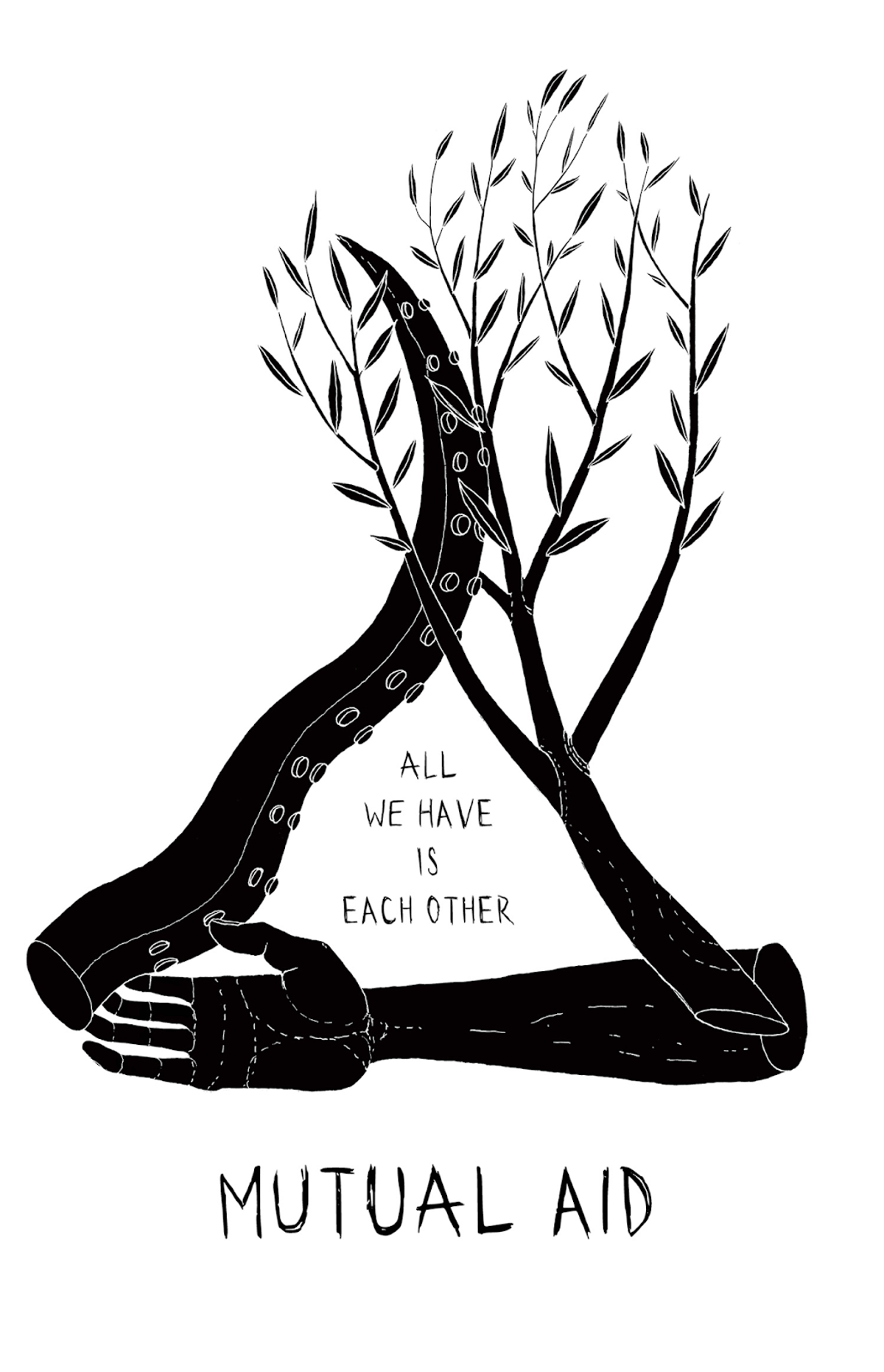
Interspecies Mutual Aid by Andrea Conte
Before we can build new structures of care and solidarity, we must first understand the landscape we’re navigating, the very conditions that take our strength and disrupt our collective power. At our convening, organisers and community members came together to map out these obstacles, naming both the external forces and internal dynamics that keep us tied to extractive systems. By laying these barriers bare, we can better chart paths around, through, and beyond them, choosing strategies that reclaim our time, our spaces, and our agency.
Some of these obstacles are laid out below:
External Barriers:
- Financial and capacity costs: Austerity cuts, especially in local councils, Time (or lack of it), Overworking to pay bills and feeling exhausted to contribute to community work
- Degradation of public space: Loss of community spaces and assets to organise, Surveillance, Anti protest and anti union laws which shrink spaces to commune.
- Media bias: lack of visibility of social movements and/or demonisation, especially for Migrants and trans people, political ghosting.
- An unnecessarily difficult funding process: Not knowing what funds are available, Constantly applying for small pots of money, Funding available is guided by a capitalist agenda and often uses inaccessible language and formats.
Within charities and community organisations, these external barriers also create internal issues:
- Replicating capitalist workplaces: Internal hierarchies of power, Financial mismanagement, Burnout and overwork, Lack of healthy boundaries
- Silencing Issues: Fear to speak up, and even apathy. Revolutionary ideas becoming watered down or censored.
When organisations are dependent on funding and paid workers to keep the work alive, the dynamics of racial capitalism rear their head again, because funding does not offer sovereignty nor does it offer agency. Nor does it create meaningful space for childcare and other caring responsibilities, or accessibility and supporting invisibilised communities to be a part of the work.
The abolitionist and mutual-aid scholar Dean Spade urges us to ask whether our funding sources bind us too closely to the very legacies we’re trying to dismantle, like philanthropists, governments, or trusts whose wealth derives from slavery, plantations, and colonial indenture. There’s a tension between surviving within the existing system (earning wages, paying bills, putting food on the table) and living in the world we want to create, one free from money and dominating power as status symbols. While compensation is necessary, if we’re serious about radical, transformative change, we must begin to imagine and build alternatives to grant-based models: financing mechanisms that don’t reproduce colonial hierarchies but instead foster genuine community sovereignty.
Beyond the Grant: Resourcing Resistance on Our Own Terms
Like the strategies of guerrilla gardening or land reclamation we briefly discussed in part 1 of this blog series, Reparations, the act of remedying and healing from gross violations of human rights, is a reclaiming strategy that communities’ can use to create sovereignty. The legacy of reparations is not confined to legal frameworks or appeals to the state. It lives on in the ways our communities organise, resist, and repair — often without seeking permission, or traditional funding models. The work of reparative justice demonstrates that resource reclamation doesn’t begin or end with institutions. It is a refusal to wait. It is sovereignty in practice.
Reparative Justice as practice of sovereignty and world-building is part of a historical legacy, and shows clearly we have alternatives to resourcing our movement through funding and grants.
Reparative Justice: A Lineage of Resistance and Reclamation
Reclaiming and relocating stolen resources is rooted in ancestral struggles, led by the brave, who refused to accept dehumanisation, servitude and exploitation as their destinies. The continued movement is a living and breathing monument, and reminder that resourcing our communities outside of racial capitalism is imperative.
Reparative Justice focuses on repairing the harm caused by wrongdoing, emphasising accountability and restitution. States and institutions do have a legal obligation under international law to provide reparations, but often this is not practised. At the root of racial capitalism is the transatlantic Afrikan holocaust, also known as the Maangamizi, which saw the murder, trafficking and enslavement of millions of Afrikan people within their homelands and across European colonial land occupations.
“Maangamizi” is a Kiswahili term describing the intentional destruction and dispossession of Afrikan peoplehood, nationhood, and relationships to Ancestral Lands through the continuum of chattel enslavement, colonialism, and neocolonialism, a process that continues today.
The reparations movement and call for repatriation stems from the Maangamizi, going back as early as 1726, when Fiaga Agaja Trudo Audati wrote to King George demanding an end to chattel slavery and human trafficking, through the creation of “local plantation agriculture” in Oudiah, Kingdom of Whydah (present-day Benin).
From the abolition struggles in London, through the rioting, political organising, and ground-breaking letter writing of the Afrikan born, formerly enslaved Ottobah Cugoano during the 1700s, to the revolutionary struggles in the Caribbean, including Tacky’s Revolt in Jamaica 1760-161, which saw uprising of enslaved people and the burning of plantations, and the 1791 Haitian Revolution, which led to a free nation established by autonomous and emancipated Afrikans, self-liberated people have long shown that reparative justice is not merely asked for, it is taken, enacted, and embodied. These moments underline a crucial truth: the fight for reparations is as much about dismantling racial capitalism’s infrastructure as it is about reclaiming stolen life, land, and labour.
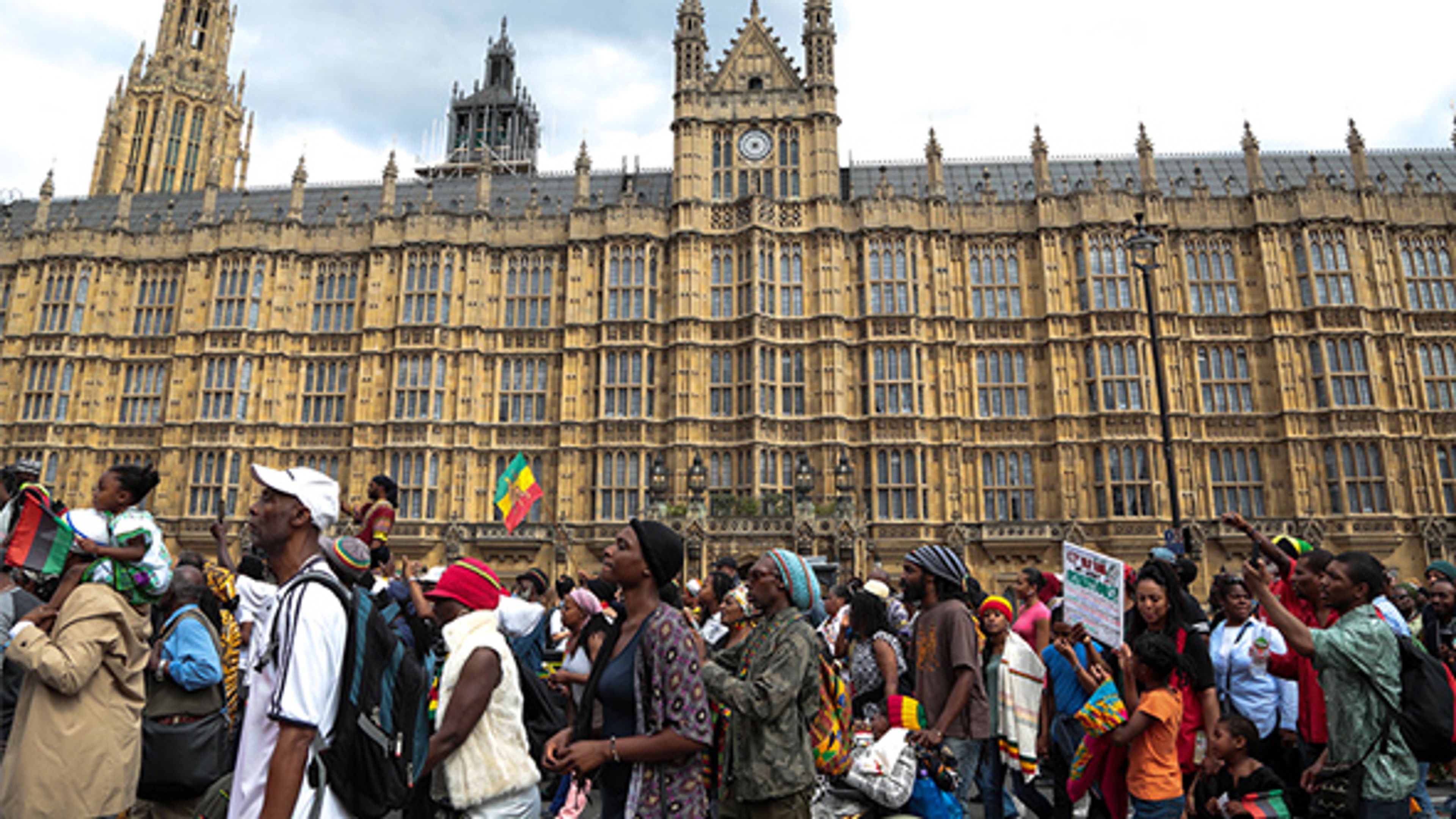
In the present day, movements like the International Social Movement for Afrikan Reparations (ISMAR) continue this legacy. ISMAR frames reparations holistically, not just as economic redress, but as a demand for spiritual, cultural, and collective repair. Its work spans grassroots community initiatives, international campaigns, and institutional accountability, including efforts toward a Parliamentary Inquiry for Truth and Reparatory Justice in the UK and the Ubuntukgotla People’s International Tribunal for Global Justice. The Mosiah Afrikan Emancipation Day Reparations March has amplified voices resisting the Maangamizi today and has helped to showcase active self-repair initiatives within Afrikan communities.
The rejection of racial capitalism, and its mechanisms like the Hostile Environment, connects our organising to this reparative lineage. The Hostile Environment is not new; it is a continuation of the Maangamizi. Recognising this shared root allows our movements to ground themselves in a longer history of resistance, one that reminds us that repair is not granted from above, but cultivated among us.
From our ancestors, we inherit not only strategies for dismantling systems but also the wisdom to build anew: grounded in care, sovereignty, and collective power.
This is how we refuse the Hostile Environment, not just by confronting it externally, but by rooting it out from our own spaces. By choosing repair, reclamation, and collective care, we honour a lineage of resistance that refuses to be governed by extraction.
In the next blog, we’ll explore what it means to imagine wealth differently. What would you do with £2 million?
We are sitting with a re-imaginging, as an experiment. An opening. A curiosity about power, about redistribution, about what becomes possible when we detach wealth from control and reattach it to care, justice, and repair.
What does it mean to hold resources collectively, with accountability and abundance? What happens when funding becomes a tool for liberation, not charity, not compliance, but collective sovereignty?
Related Articles
One Year After Dr Pious Nyandoro: The Uncomfortable Truth About Empire, Borders and the Value of Black Life
23/07/2026 • Boucka Koffi
Press release: Afro-Diasporic Futures: Black Women’s Leadership Across the Atlantic
04/05/2026 • Iris Dixon